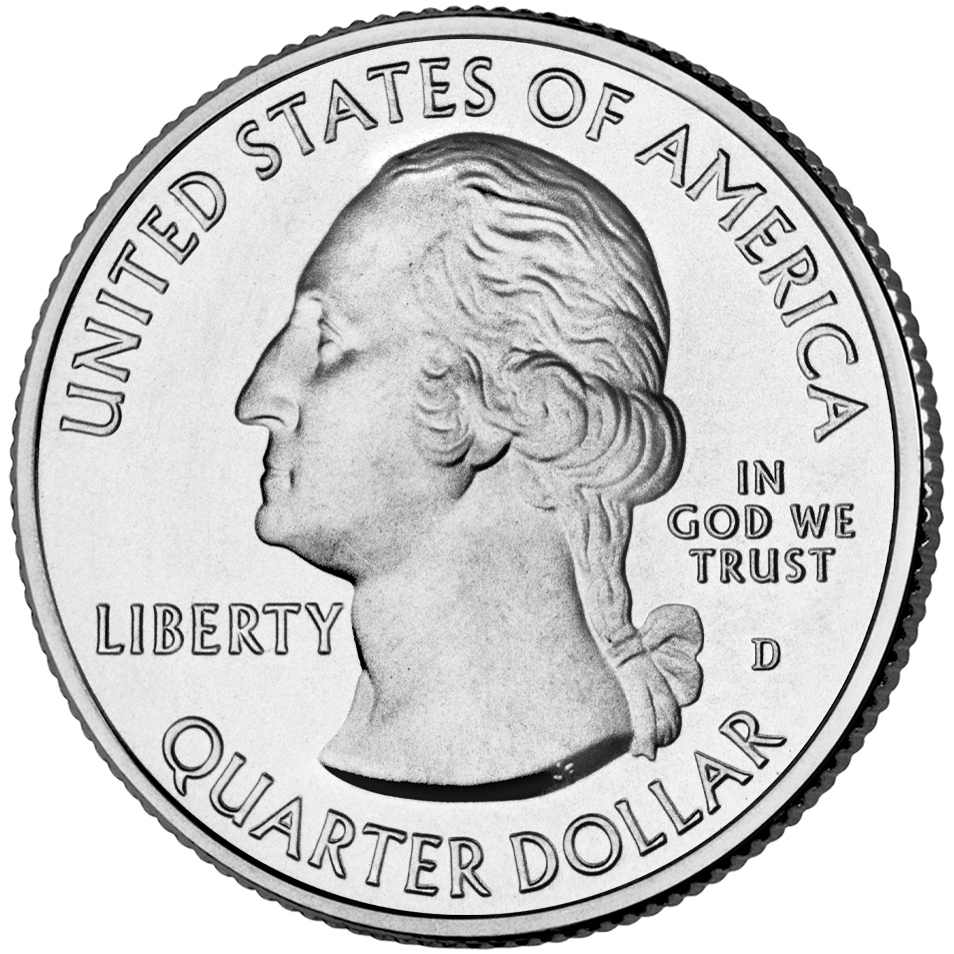
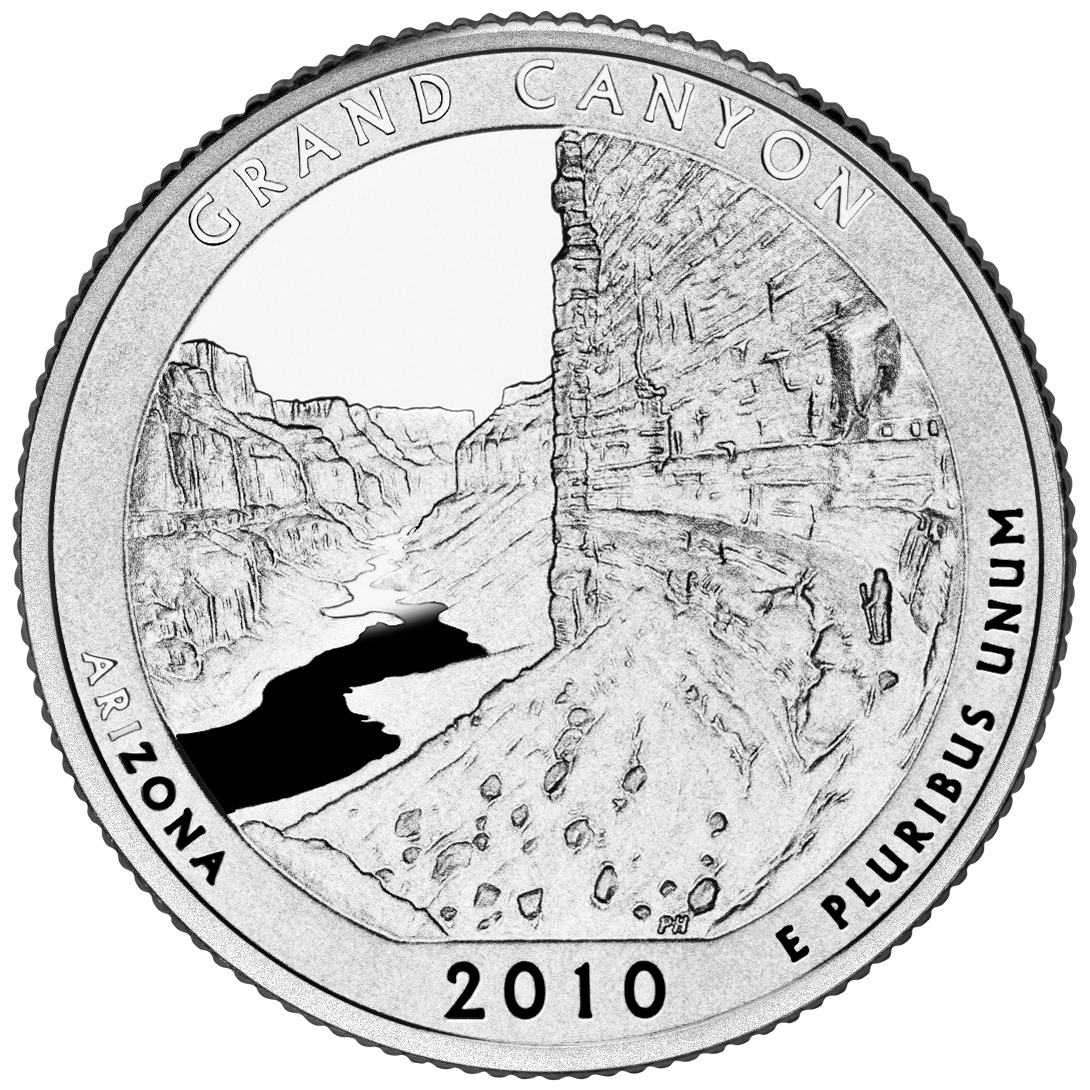
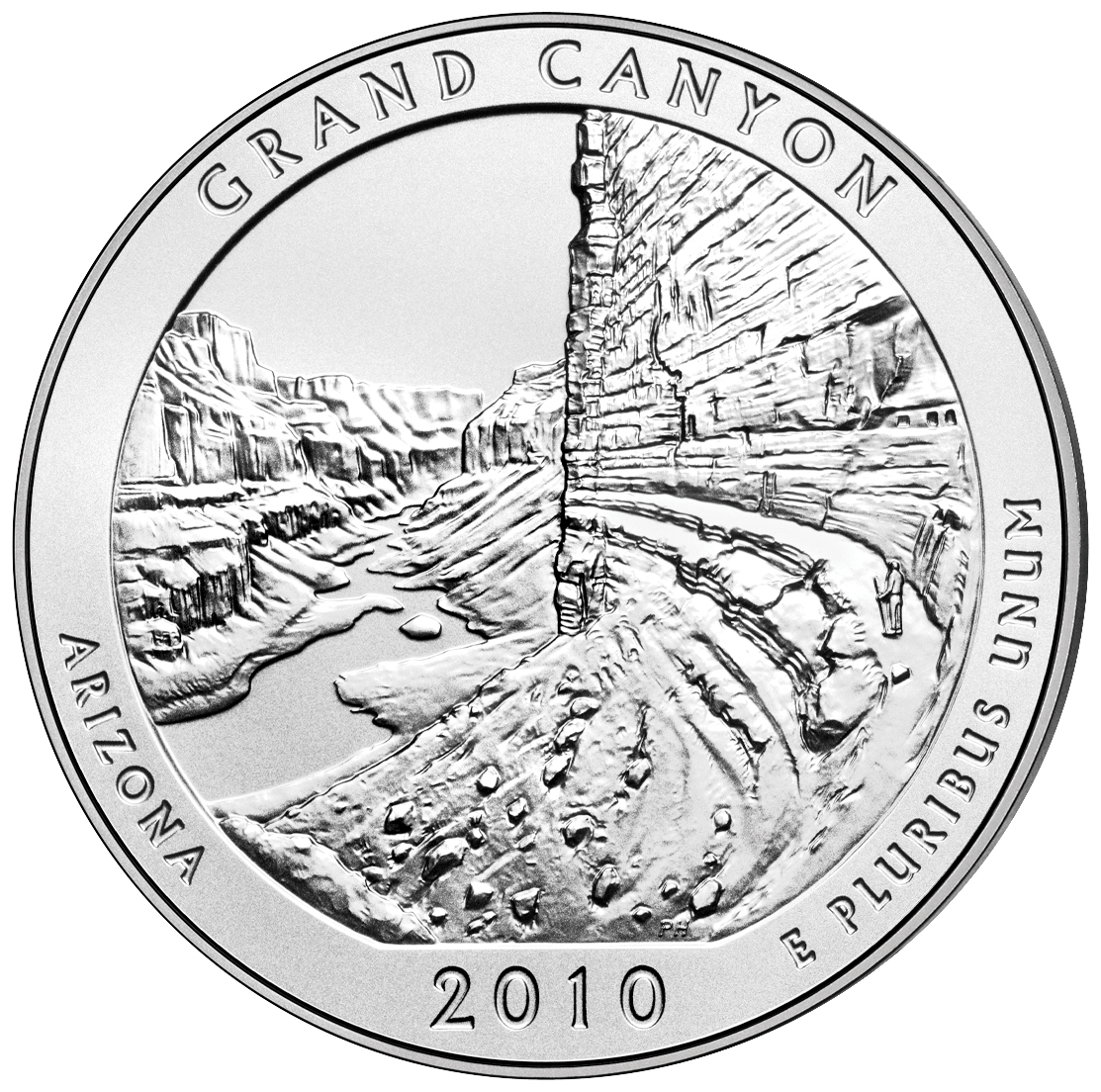
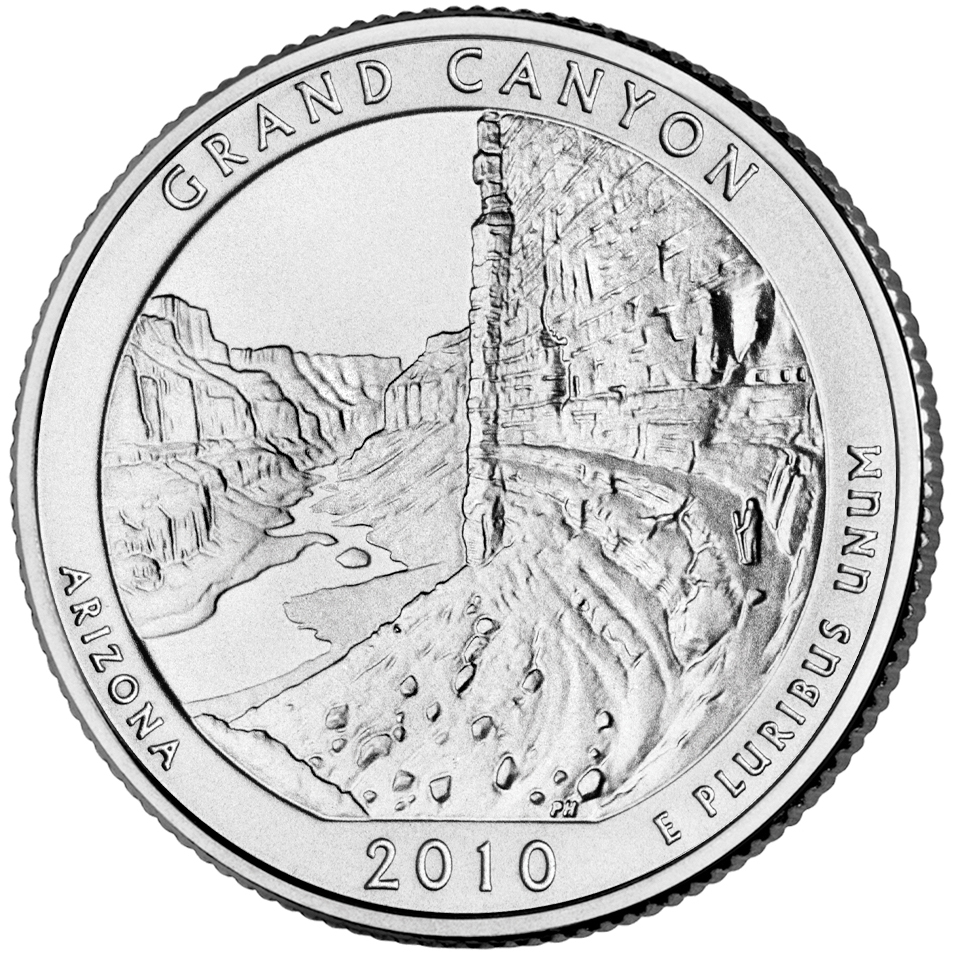
The Grand Canyon National Park Quarter is the fourth coin of 2010 in the America the Beautiful Quarters® Program. The reverse image features a view of the granaries above the Nankoweap Delta in Marble Canyon near the Colorado River. Granaries were used for storing food and seeds (AD 500). Inscriptions are GRAND CANYON, ARIZONA, 2010 and E PLURIBUS UNUM. Design candidates were developed in consultation with representatives of Grand Canyon National Park.
At least 1.8 billion years in the making, Grand Canyon National Park is truly grand in every way. While the oldest rocks exposed in the bottom of the canyon are that old, the canyon is a new geologic feature carved over the last 5-6 million years.
Averaging 4,000 feet deep for its entire 277 miles, stretching 277 river miles from Lees Ferry to the Grand Wash Cliffs, it is 6,000 feet deep at its deepest point and 15 miles wide at its widest. But this immense chasm dug by the Colorado River isn’t considered one of the natural wonders of the world just because of its staggering numbers.
It’s also a scientific wonder, one of the most complete records of geological history that can be seen anywhere in the world. Beautiful and inspiring, it’s a landscape that is constantly changing with variations in the weather and time of day.
Whether by plane, helicopter, boat, foot, horse or pack mule, it’s no wonder that four-five million people every year have found so many ways to experience it.
Trips on the Colorado River in a variety of crafts range from lazy float-downs to white-knuckle rafting. Most trips last between 7 and 18 days.
The oldest human artifacts found in the park are nearly 12,000 years old and date to the Paleo-Indian period. The park has recorded over 4,800 archeological resources with an intensive survey of nearly 3% of the park area.
Over 1,500 plants, 355 birds, 89 mammals, 47 reptiles, 9 amphibians, and 17 species of fish are found in the park. The elk found within Grand Canyon National Park weigh as much as 1,000 pounds. The Grand Canyon pink rattlesnake is found only within the canyon.
The Grand Canyon Railway carries more than 230,000 people by rail from Williams, Arizona, to Grand Canyon National Park each year.
No one has ever found a fossilized reptile skeleton or bone within the Grand Canyon. Fossil footprints were left by more than 20 species of reptiles and amphibians, but no teeth or bones.
The Grand Canyon boasts some of the nation's cleanest air, with visibility averaging 90 to 110 miles.
Summer temperatures on the South Rim are relatively pleasant 50 to 80 degrees Fahrenheit, but inner canyon temperatures are extreme. Daytime highs at the river, 5,000 feet below the rim, often exceed 100° F.
One and two-day mule rides are available from the South Rim to the canyon bottom. Overnight riders stay and eat at Phantom Ranch. Mule trips may be booked 13 months in advance and fill up early.
Because of its 8,000-ft. elevation, the North Rim of the park is only open from May through October.